
Lampang Heritage Journey: Rails, Carriages & Timeless Wonders
Make an historic train ride to Lampang and explore the history of former teak capital of Siam
This is a private trip. Lampang is one of the most undervisited and authentic destinations in North Thailand. It has hardly been affected by tourism and modernity. The city has many interesting and beautiful historical sites and has the most Burmese and Shan temple architecture than any city in Thailand. For a long time Lampang was the economic and political center in North Thailand, not Chiang Mai. That changed gradually in the 1950s and 60s. This trip is a more relaxed version of our day tour to Lampang. Of course, the amazing half-day train ride makes this trip worthwhile to start with. Lampang is a slow travel destination.
| Price per person in THB | ||||||
|---|---|---|---|---|---|---|
| 2 persons | 3 persons | 4 persons | 5 persons | 6 persons | 7 persons | 8 persons |
| 4,400 | 3,400 | 2,900 | 2,600 | 2,400 | 2,300 | 2,200 |
From: 4,400.00 ฿
Day 1: Chiang Mai – Lampang
The historical train ride through the Khuntan Tunnel
Your guide and driver will meet you at your hotel in Chiang Mai at 0800 to begin your Lampang Heritage Journey: Rails, Carriages & Timeless Wonders. We will bring you to the Chiang Mai Railway Station to board Local Train No. 408 to Nakhon Sawan, departing at 0900. This unique journey takes place on the only non-air-conditioned train along this section of the Northern Line, offering unobstructed views for photography enthusiasts. The train travels in 3rd class, so while it lacks modern comforts, it provides an authentic and charming experience. Along the route, you’ll stop at ten local historic railway stations. These stations have not changed much since the opening of the line in 1922. This local train is the only train service that stops at these stations.


Scenic Highlights Along the Northern Line
The Northern Line is Thailand’s only railway passing through a national park. As the train approaches the Doi Khuntan National Park, you will cross the iconic Tha Chomphu Bridge. This bridge is also known as the White Bridge, built in 1919. This elegant structure is a favorite photography spot. As the train climbs to Khuntan Station you’ll enjoy spectacular mountain views. It is situated at 573 meters above sea level, the highest station on the Northern Line.
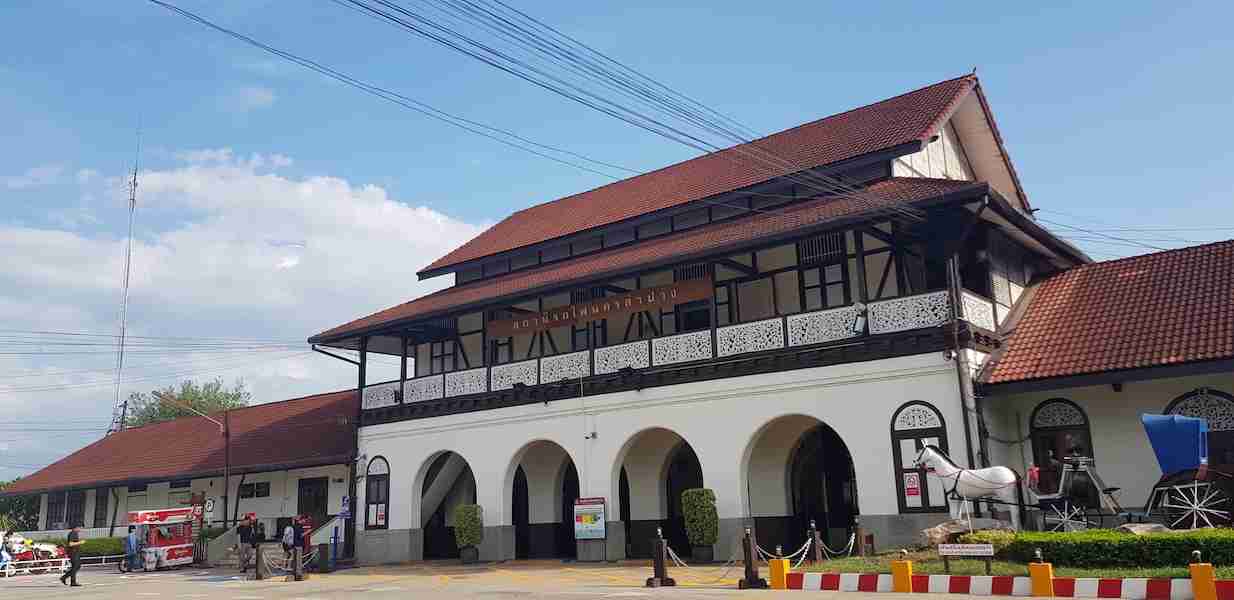
After a brief stop at Khuntan Station, the journey continues through the historic Khuntan Tunnel. This is Thailand’s longest railway tunnel at nearly 700 meters, an engineering feat completed in 1921. From there, the train descends into the plains of Lampang, where the landscape shifts to typical countryside. Your journey concludes at the historic Lampang Railway Station, where you will disembark at approximately noon. From there we will drive to the charming restaurant Baan Phraya Suren by Madame Musur, where we will have lunch.


Lunch at a restored landmark
Baan Phraya Suren takes its name from its origins as the home of Phraya Suren, Lampang’s first governor. According to local information they constructed the house between 1890 and 1904, during the reign of King Chulalongkorn (Rama V). After the restoration, Madame Musur, a company from Bangkok, rented the house and opened a restaurant next to it a couple of years ago. The old, restored house exhibits old furniture and photographs from the era of the booming teak industry. After having visited the house, we will enjoy a delicious lunch in the stylish restaurant next to it.


A ride by traditional horse carriage
After lunch we will drive a short way to the place where our horse carriages are waiting. From here you will make a short ride through the streets of Lampang to the former house and office of the Louis Leonowens Company. Known locally as “Baan Louis” this century-old structure is more than just a building. It’s a window into Lampang’s past as a thriving hub of the teak trade. It is also a testament to the colorful life of its namesake, Louis T. Leonowens. This house is the former office of the Louis T.Leonowens Company involved in teak logging a hundred years ago. Louis Leonowens was the son of Anna Leonowens.


The Louis T.Leonowens House
The Louis Leonowens House is a reminder of the region’s historical ties to foreign trade and the cultural influence of the British Empire in Southeast Asia. It also holds a special place in the story of Anna Leonowens, who became famous as the governess of the children of King Mongkut (Rama IV). Anna’s memoirs about her experiences at the Thai court were later adapted into the well-known play and film, “The King and I”.
The restored house retains its original charm. The teak walls and floors polished to a warm glow, intricate woodwork accentuating its colonial style. Today, it serves as a small museum, offering visitors a glimpse into Lampang’s teak trade history and the Tha Ma-O neighborhood’s cultural evolution. Displays highlight the region’s logging past and Louis’s role in it.


The Magnificent Wat Phra That Lampang Luang
Our last visit today will be to Wat Phra That Luang, one of the most authentic and revered temples of North Thailand. The temple is about 20km from the City of Lampang but more or less on the way back. What sets the temple apart is its well-preserved Lanna-style architecture. This is a rarity in a country where many temples have been modernized. When you walk up the staircase flanked by two serpentine nagas (mythical dragons) and enter the temple it is like stepping back in time. With its high brick walls Wat Phra That Lampang Luang, built on a mound, resembles a fortress.
The big assembly hall dates back to 1476. The 45-meter-high chedi is believed to contain a relic from the Buddha. It has not been gilded, like many chedis in North Thailand, adding to the authenticity of the temple. After this we return to Chiang Mai where we will arrive between 1700 and 1800. We hope you enjoyed our Lampang Heritage Journey: Rails, Carriages & Timeless Wonders.


Inclusions
What is included
Transportation by private AC car
English speaking guide
Sightseeing as indicated
Lunch
Entrance fees
Horse carriage ride
Drinking water during lunch
What is not included
All drinks except drinking water during lunch
Personal expenses
Tips
Other expenses that are not mentioned in the itinerary
Timeline
Day 1:
08.30 – Transfer from hotel to the Chiang Mai Railway Station
09.30 – Board the train to Lampang
11.39 – Arrival at the Lampang Railway Station<br />12.30 – Lunch at the Baan Phraya Suren by Madame Musur
13.30 – Drive to the start of the horse carriage ride
14.00 – Horse carriage ride
15.00 – Drive to Wat Phra That Lampang Luang
15.30 – Wat Phra That Lampang Luang
16.15 – Drive back to Chiang Mai
18.00 – Arrival back in Chiang Mai
What to bring/How to dress
How to dress
As you will be visiting many Buddhist temples today we recommend long trousers and shirts that cover the shoulders.
What to bring
A cap or hat against the sun
Easy walking shoes
Related products


Multi-day tours

Multi-day tours
