
Chiang Mai Food and Culture Tour by samlor
Explore the markets of Chiang Mai and taste traditional food – Private Tour
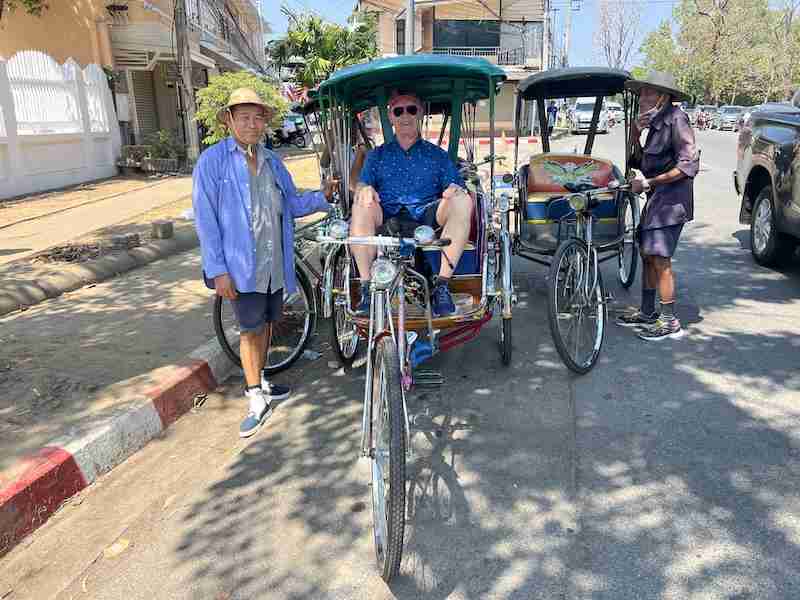
Your Chiang Mai Food Tour by Samlor is a tasty and historical trip. You will learn about the different cultures in Chiang Mai and visit the two of the most interesting markets: the San Pakoy Market and Kad Luang, the “big market” on the Ping River. Both these markets have a long history and the vendors go generations back. We will not only let you taste different snacks and dishes but we will also tell the story behind this food. There is a story behind everything you taste. Some of the food originated in countries such as Vietnam, China. You will also taste “sai ua”, the typical Northern Thai sausage. You will also meet some of the people who produce or sell this food. The means of transportation is the traditional bicycle taxi aka the “samlor”. By using the samlor we support the mostly elderly drivers and help preserve this tradition for the future. We only do this tour in the morning.
| Price per person in THB | ||||||
|---|---|---|---|---|---|---|
| 2 pax | 3 pax | 4 pax | 5 pax | 6 pax | 7 pax | 8 pax |
| 2,000 | 1,800 | 1,700 | 1,600 | 1,500 | 1,400 | 1,300 |


From: 2,000.00 ฿


Chiang Mai Food and Culture Tour by samlor
A bewildering variety of food and drink
Your private Chiang Mai Food Tour by samlor will start at 0830 at Wat Loi Kroh. Here your samlor drivers and guide will be waiting for you. After an introduction and short instructions, we will be on our way. We will often stop for photos. Chiang Mai is a melting pot of Chinese, Indian, Vietnamese, Burmese, and western influences. You can find these influences in religious architecture but also in food, drinks, and snacks. Food is an intangible, living cultural heritage of Chiang Mai.
Our first stop will be at the Ban Ho Mosque, the first mosque in Chiang Mai, dating back to 1916. From here we continue to the oldest, non-religious structure of Chiang Mai: the Lanna Ancient House. It now houses a restaurant. We have now arrived at the Ping River. After a short explanation we will walk across the famous Iron Bridge. This bridge, also known as Saphan Lek, was constructed in the late 1980s/early 1990s. According to some people they constructed as a kind of homage to the steel Nawarat Bridge that was demolished in 1965.


Vietnamese pancakes at the San Pakoy Market
From the Iron Bridge we continue to the San Pakoy Market. Over the centuries, migrants from different countries brought their favorite specialties along to Chiang Mai. Our first stop will be at a stall where a local woman prepares sizzling Vietnamese pancakes (Vietnamese: bánh xèo). It is made of rice flour, water, and turmeric and powder and contains bean sprouts and tofu amongst other ingredients. In Thailand they call these crispy pancakes khanom bueang (Thai: ขนมเบื้อง).


Taste Khanom Krok and “Sai Ua”
At another stall two brothers produce “khanom krok” (Thai: ขนมครก), coconut-rice pancakes or mortar toasted pastry. The dough of khanom krok consists of rice flour, sugar, and coconut milk mixed together. We let you taste khanom krok, a delicious traditional Thai desert. We spend some time at this attractive market, visit a shop with a coconut grinder. Finally, we visit one of our favorite stalls where they produce a famous and typical northern Thai sausage, known as Sai Ua (Thai: ไส้อั่ว).


A historic salapao shop
Don’t eat to much of it because after this we will continue to Wikunpanich, a famous “salapao” shop. Salapao is a steamed bun that contains either pork or black beans. The Thai-Chinese family that runs the Wikunpanich started more than 80 years ago and most Chiang Mai locals know this store.


Kad Luang, the “Big Market”
We continue to Kad Luang, the complex of the two most famous markets of Chiang Mai: the Warorot and Ton Lamyai markets. Our samlors will bring us to Wat Ket Karaam, the temple of the dog. From here we cross the Chansom Memorial foot bridge to the most famous and colorful market of Chiang Mai. We are in the “Chinatown” of Chiang Mai. We take our time to visit some of the many stalls. There is plenty of time for interaction and pictures. At some places, you will see delicious snacks being prepared in front of you. We let you taste some of the smaller delicacies such as caramel or something else.


Final ride through Tha Pae Street
We slowly make our way towards the Pung Tao Gong Temple, the oldest Chinese Ancestral temple. Here our samlors are waiting to bring us to the Tha Pae Gate, where this tour ends. Please note the heritage houses in the main street of Chiang Mai. They were constructed after the arrival of the railway in 1922, mainly by Chinese immigrants. We hope you enjoyed our Samlor Food and Culture Tour of Chiang Mai.


Please note that we don’t run these tours on Sunday. When one of the stall mentioned in the itinerary is closed on the day of the tour we will offer an alternative.
Of course, we can accommodate vegetarians on this trip. Please inform us before the trip. Thanks very much for joining this tour and supporting the samlor community of Chiang Mai. More things to do in Chiang Mai you will find here.
Highlights
Ban Ho community
Lanna Ancient House
Iron Bridge
San Pakoy Market
Khanom bueang
Khanom krok
Sai Ua, Northern Thai sausage
Salapao
Wat Ket Karaam
Kad Luang (Warorot and Ton Lamyai markets)
Two snacks at Kad Luang
Pung Thao Kong Shrine
Inclusions
What is included
Transportation by Samlor, a traditional bicycle taxi – one person per samlor
English speaking guide
Khanom bueang
Khanom krok
Sai Ua, Northern Thai sausage
Salapao
Two different snacks at Kad Luang
Fruit of the season
Drinking water
Limited Medical Insurance
What is not included
Transfer from the hotel to Wat Loi Kroh where the tour starts
Transfer from Tha Pae Gate to the hotel
Personal expenses
Tips
Timeline
0830 – Departure at Wat Loi Kroh
0845 – Ban Ho Mosque
0915 – Continue to San Pakoy Market via the Lanna Ancient House and the Iron Bridge
0930 – San Pakoy Market
1000 – Continue to Wikul Salapao shop (Chinese).
1010 – Arrival Salapao shop
1030 – Continue to Wat Ket
1045 – Arrival at Wat Ket
1100 – Cross the footbridge to Kad Luang
1110 – Kad Luang
1200 – Continue to Burmese tea shop
1230 – End at Thapae road
Related products


Multi-day tours


Day Tours